Bashtovë
A Venetian river fortress standing alone on a plain, cut off from the water it was built to command.
- Entry
- D.2
- Where
- Shkumbin plain, Kavajë
- Period
- Venetian, fifteenth century
- Section
- Towers of the Coast
01The fort and its position
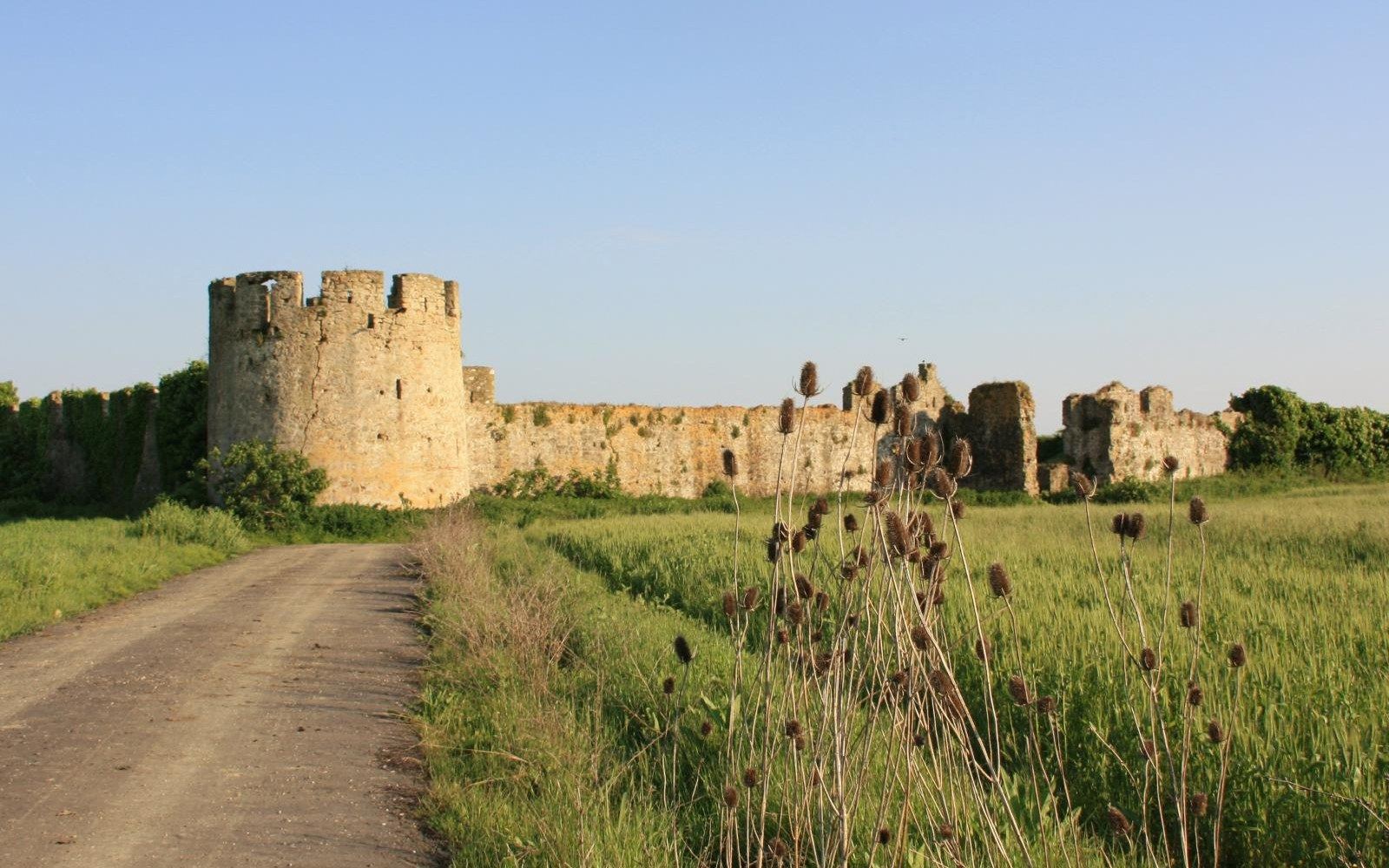
Bashtovë stands on flat agricultural land a few kilometres from the Albanian coast, between Durrës and Vlorë, where the Shkumbin river meets the lowland plain before finding the sea. It is a rectangle of high stone curtain wall with a round tower at each corner, the plan orthodox Venetian military architecture of the fifteenth century, built to hold a position rather than to dominate high ground. There is no village around it now, no road junction beneath its gate — just the walls, the towers, the sky, and the river that is no longer there.
That absence is the key to reading the site. When Venice built Bashtovë in the early fifteenth century, the Shkumbin ran close enough to the walls that the fort controlled both river traffic and coastal access. The Adriatic shore was nearer too: the lagoon and river mouth formed a natural anchorage that made the position worth holding. Venice understood the Albanian coast as a series of such pinch points — river mouths, inlets, narrows — and fortified each one as a link in the chain running south from Shkodër toward Vlorë. Bashtovë was one link, placed at the Shkumbin crossing because the river was, at that moment in its history, an artery worth guarding.
Rivers on alluvial plains do not stay where they are put. The Shkumbin migrated south over the centuries, as rivers across this coastal strip have done repeatedly, depositing sediment, cutting new channels, abandoning old ones. The anchorage silted. The lagoon retreated. What had been a waterside fortress became an inland one, and an inland fortress without road or river loses its reason. Bashtovë was not destroyed or abandoned in a single event; it simply became peripheral, and periphery preserved it. There was no later building campaign to alter the walls because there was no later use demanding alteration.
- Early fifteenth centuryVenetian construction of the fortress
- Late fifteenth centuryOttoman control of the Albanian coast extends to the site
- Post-medievalShkumbin river migrates south; anchorage silts; fort becomes inland structure
- Subsequent centuriesno significant rebuilding; walls preserved by disuse
02What survives and what it shows
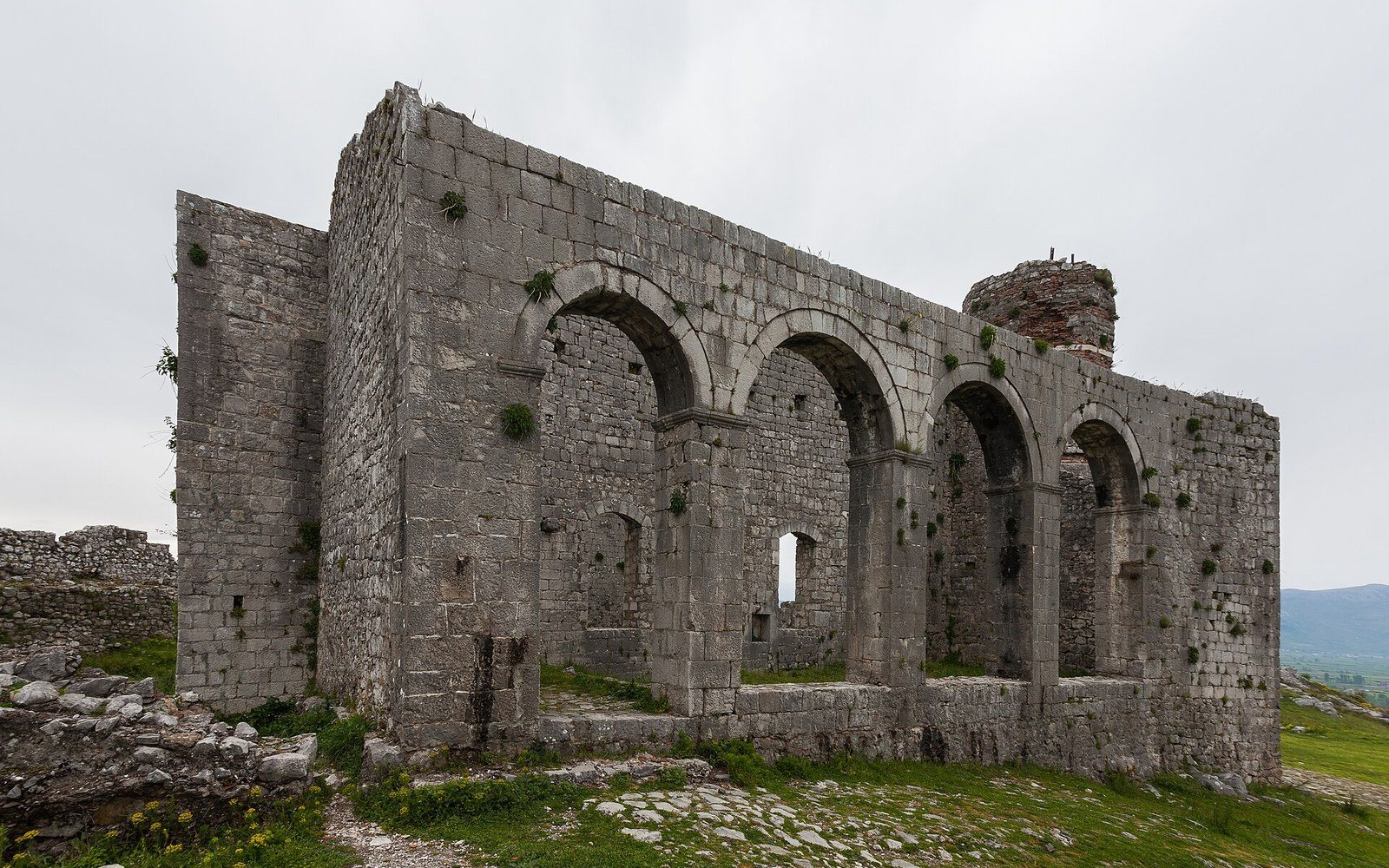
The four curtain walls survive to near their full height in most sections, enough to read the full rectangle. The corner towers are round in the Venetian manner — round towers deflect cannon shot better than square ones, and the Venetians were building with artillery in mind by the time Bashtovë went up. The gate is on one of the long sides rather than centered on a short end, a practical choice on a flat site where approach could come from several directions. Inside the enclosure the ground is empty: whatever timber structures once occupied the interior are long gone, and no masonry building survives within the walls.
The stone is local, laid in roughly coursed rubble with lime mortar, the same material and method used across Venetian Albania wherever dressed ashlar was not worth the cost of transport. Compared with the elaborate carved stonework of Venetian civic building in Durrës or the elaborate military engineering at Rozafa above Shkodër, Bashtovë reads as a functional outpost rather than a prestige fortification: built to last, built to work, and built without ornament because ornament was not the point.
The walls that stand are substantially the walls Venice built.
The Ottoman period left no significant layer here. Bashtovë passed out of Venetian control in the late fifteenth century as Ottoman authority extended along the coast, but the site was not remade or garrisoned heavily — its value had already diminished with the river. It appears in later Ottoman records and maps as a known place, a named point on the coastal plain, without evidence of substantial rebuilding. The walls that stand are substantially the walls Venice built.
What the fort does clearly, even now, is demonstrate how Venetian military thinking mapped itself onto this particular coast: identify the water, build beside it, hold the crossing. The thinking was sound. That the water then moved is not a failure of planning but a reminder that the physical premises of a military decision — a river channel, a lagoon, a depth of water — are themselves temporary. Bashtovë remains because it was built well and then left alone. It sits on its plain as a measure of how much the landscape around it has changed since the fifteenth century, which is to say, considerably.
- Rectangular enclosure with round corner towers
- standard Venetian military layout for artillery-era fortification
- Round towers
- chosen to deflect cannon shot rather than absorb it flat-on
- Gate placed on a long side
- practical on level ground where approach is multi-directional
- No surviving interior masonry
- timber structures decayed; enclosure now open ground