Karavasta
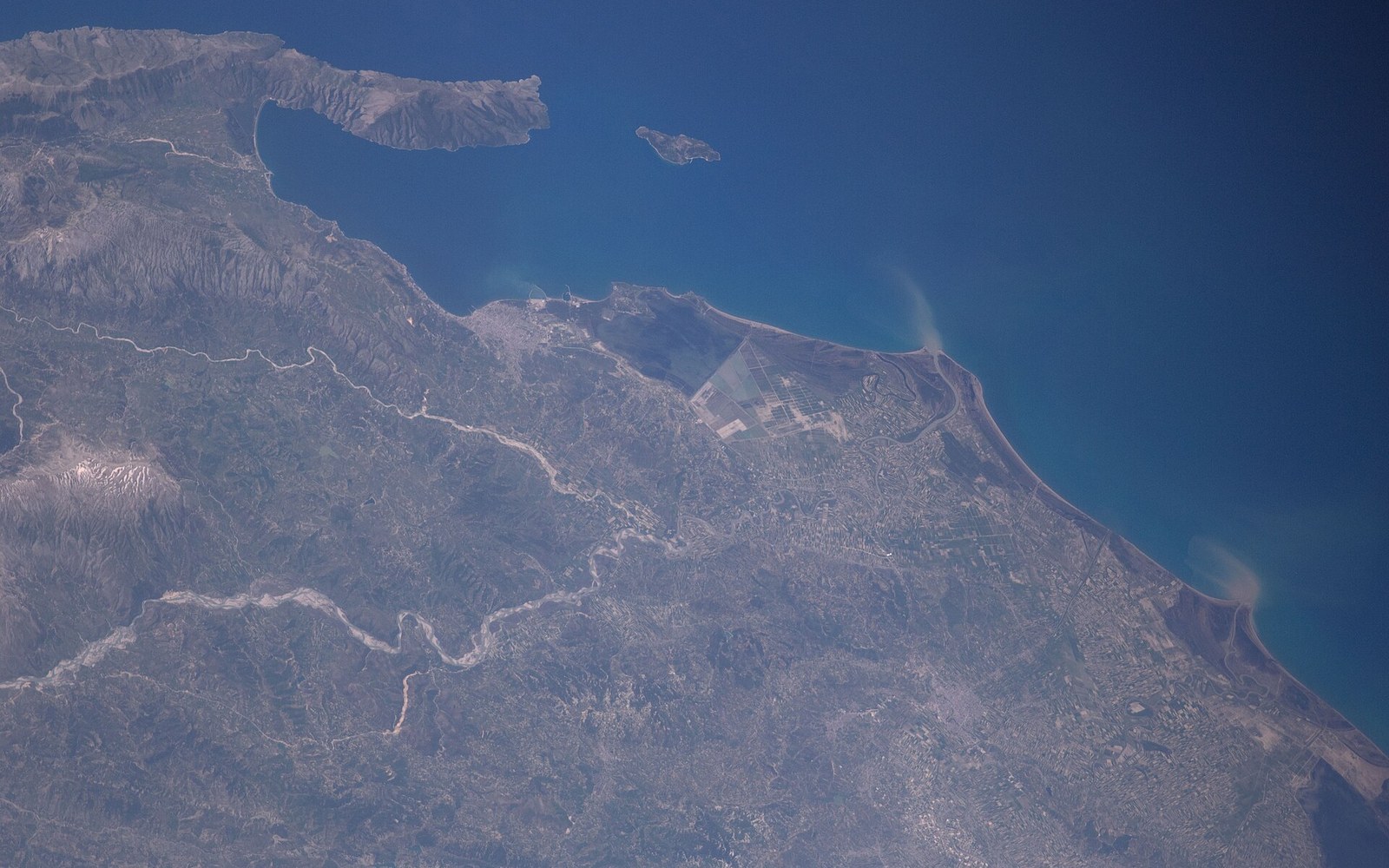
A large lagoon held behind a sand spit on Albania's central coast, where Dalmatian pelicans breed on low islets and the dune ridge behind them is one of the longest on the Adriatic shore.
- Entry
- G.1
- Where
- Divjakë, the central coast
- Period
- Holocene, still forming
- Section
- The Lagoons
01The lagoon and its enclosure
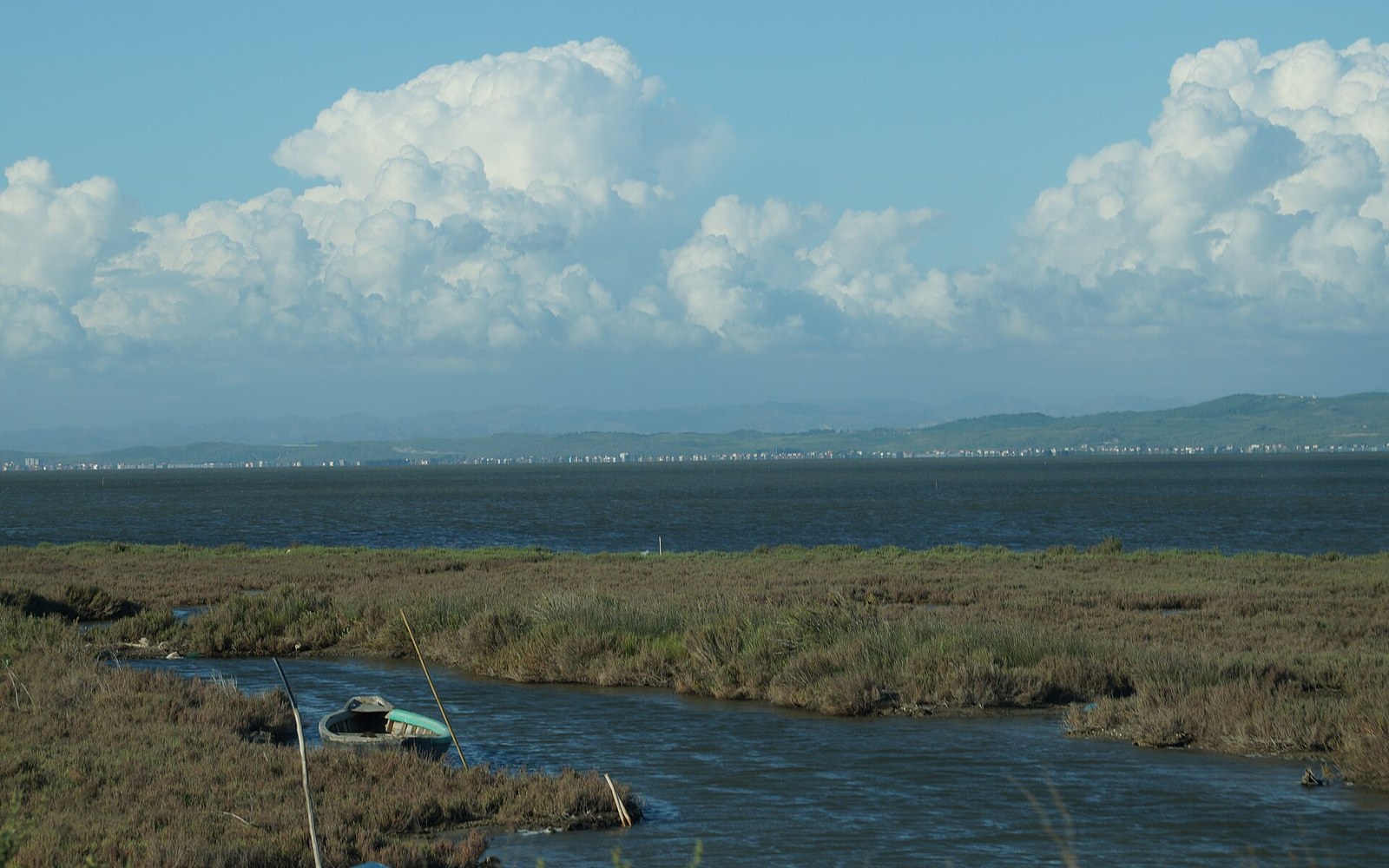
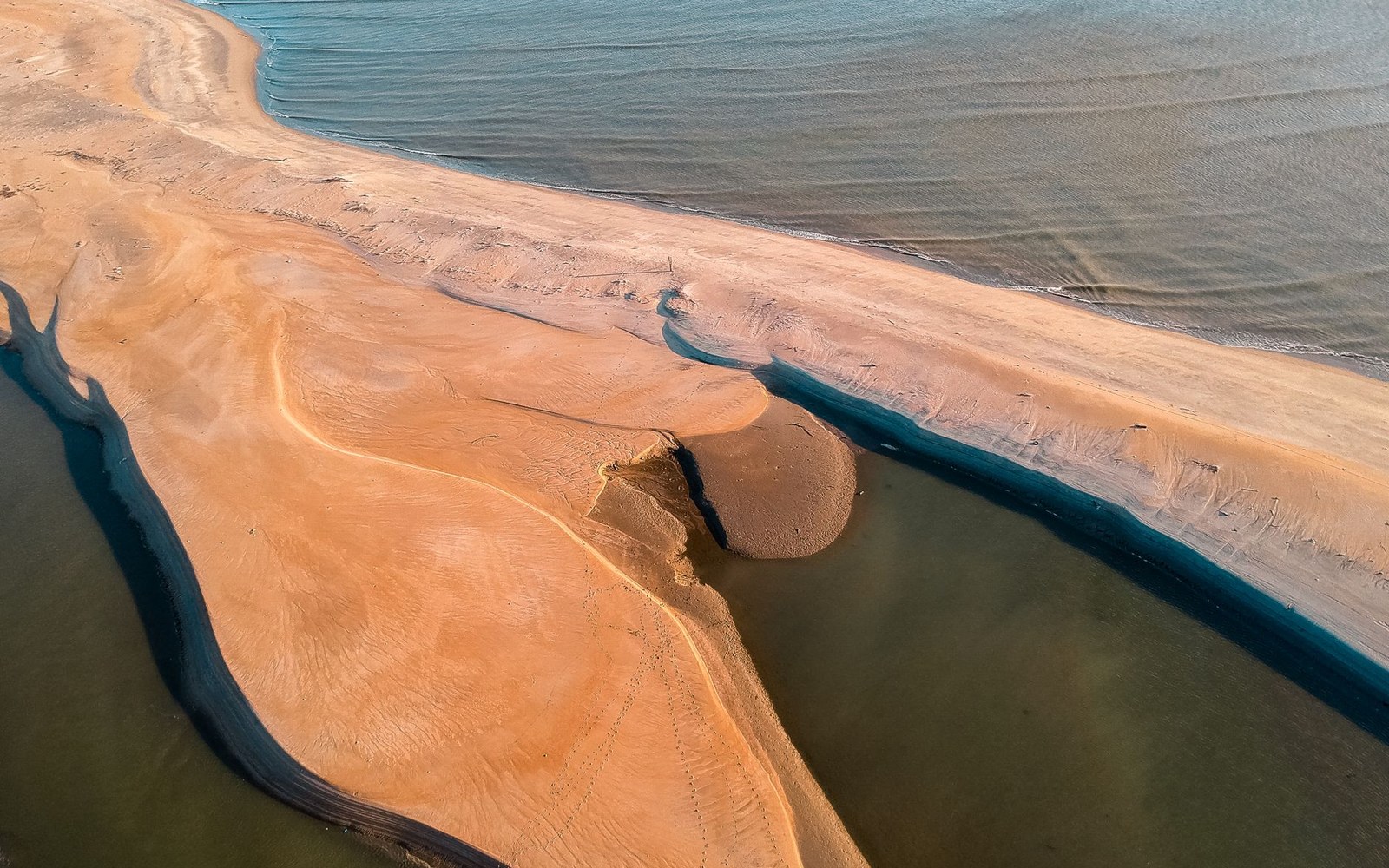
Karavasta sits on the central Albanian coast, south of the Shkumbin river delta and north of the Seman, its waters separated from the open Adriatic by a narrow spit of sand several kilometres long. The spit is not fixed geography — it is the current position of an ongoing argument between longshore drift, river sediment and wave energy, the same process at work along every low Albanian shore. Behind the spit, the lagoon runs to roughly 4,500 hectares, making it the largest coastal lagoon in Albania and one of the more significant wetlands on the eastern Adriatic. The water is shallow throughout, brackish rather than salt, and changes character seasonally: lower and more concentrated in summer, refreshed and diluted when autumn rains push the rivers up.
A dune system backs the spit on its seaward side, built from sand the waves deliver and the wind redistributes inland. The dunes are not high by Atlantic standards, but they are extensive and comparatively intact — unusual on a coast where development has consumed similar formations elsewhere. Reed beds occupy the lagoon's inner margins, and the transition from open water to reed to fixed dune to low scrub represents something close to a complete lagoonal sequence, each zone dependent on the one beside it.
02The pelicans and the islets
The small islets scattered across Karavasta's interior are the reason the lagoon is known beyond the region. Dalmatian pelicans — Pelecanus crispus, the larger and rarer of the two European species — breed here in numbers that make Karavasta one of the bird's significant Mediterranean colonies. The species requires undisturbed, low-lying ground near shallow fish-rich water, conditions the lagoon's islets provide. The breeding population is not stable from year to year; it responds to water levels, fish availability and disturbance. Numbers have fluctuated across decades, but the colony has persisted, which distinguishes Karavasta from sites where Dalmatian pelicans were once recorded and are now absent.
The pelican is conspicuous by any measure: a large, pale, curly-crested bird visible at considerable distance. It feeds by fishing in shallow water, often in loose groups that work a stretch of lagoon together. Outside the breeding season, the birds disperse; the colony's presence is concentrated in spring and early summer, when the islets are occupied and nest counts can be made.
The lagoon's fish are also its economic fact. Fishing has been practised here, by various means and under various arrangements, for a long time. Traditional stake-net structures and small boat operations are part of the lagoon's working life, not simply its scenery. The fish taken — grey mullet, sea bass, eel — move between the lagoon and the sea through channels in the spit, their migrations setting the rhythm of the fishing year.
03The enclosing landscape
Karavasta sits within the Divjakë-Karavasta National Park, which takes in both the lagoon and the Divjakë pine forest on the coastal plain immediately inland. The forest is largely Aleppo and stone pine, planted in parts but naturalised across a wide area, and it functions as a buffer between the lagoon system and agricultural land behind it. The pine woodland has its own character — dry, resinous, with a ground layer that manages desiccation — distinct from the wet margins of the lagoon it borders.
The plain behind is flat and formerly marshy, drained over the course of the twentieth century for cultivation. What remains of the original wetland is Karavasta itself, preserved by the difficulty of draining a lagoon that is in constant, slow exchange with the sea. The spit is its accidental guardian: as long as it holds, the lagoon holds with it.
- Dalmatian pelican (Pelecanus crispus)
- rarer of two European species; breeds on interior islets
- Brackish water
- salinity changes seasonally with river input and evaporation
- Lagoonal sequence
- open water / reed bed / dune / scrub, comparatively intact